
Caring for a child who has CLN2 disease can be emotionally and physically demanding. Connecting with other parents and healthcare professionals can help make the disease easier to manage. Fortunately, there are support resources available to you and your family.
The BDSRA is committed to providing family support services and has experience coordinating travel logistics for CLN2 families. If you have a child with CLN2 disease, the BDSRA welcomes you and wants to answer your questions.
Join the BDSRA community at bdsrafoundation.org or 1-800-488-4570. Contact Morgan DeBoth, BDSRA’s Manager of Family Support at mdeboth@bdsra.org.

Created by a family with 2 children affected by CLN2 disease, this organization has raised funds for research all over the world.

Dedicated to raising awareness and funding for research, this site shares support and experience from a family raising a daughter with CLN2 disease.
Layla is a patient with CLN2 disease.
She’s been on treatment with Brineura since 2015.
Newly diagnosed parents should reach out to the BDSRA. They are there for just that, support. They can connect you to other families going through similar stories. They can just point you in the right direction. They’re the best people to reach out to.
—Maria, Layla’s mom
Download the following materials to help guide you on your own Brineura journey.
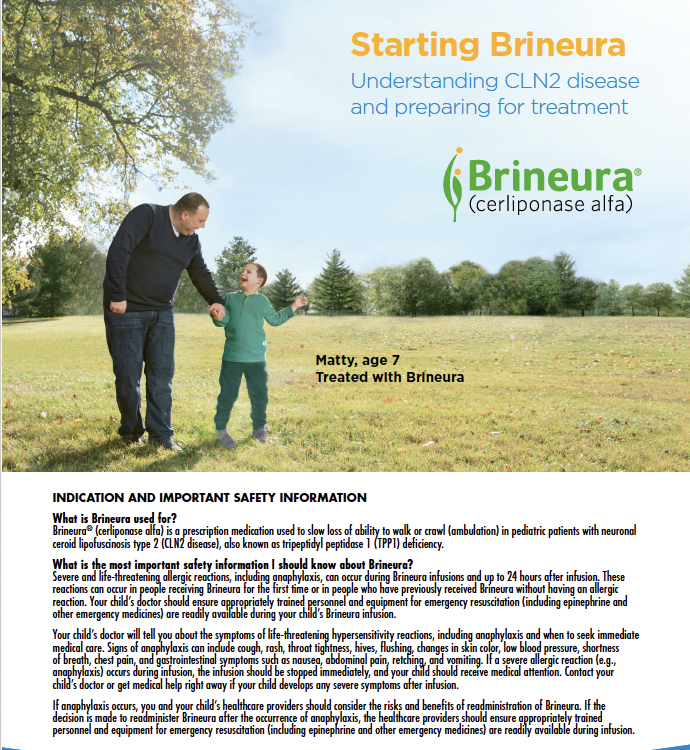
This convenient brochure gives you a quick introduction to Brineura® (cerliponase alfa) and helps you and your family prepare for treatment.

This roadmap highlights major steps that you and your child may take on your road to Brineura treatment.
This document educates patients about Brineura. It includes instructions for use and safety information.
WARNING: HYPERSENSITIVITY REACTIONS INCLUDING ANAPHYLAXIS
Patients treated with enzyme replacement therapies have experienced life-threatening hypersensitivity reactions, including anaphylaxis. Anaphylaxis has occurred during the early course of enzyme replacement therapy and after extended duration of therapy.
Initiate BRINEURA in a healthcare setting with appropriate medical monitoring and support measures, including access to cardiopulmonary resuscitation equipment. If a severe hypersensitivity reaction (e.g., anaphylaxis) occurs, discontinue BRINEURA and immediately initiate appropriate medical treatment, including use of epinephrine. Inform patients of the symptoms of life-threatening hypersensitivity reactions, including anaphylaxis and to seek immediate medical care should symptoms occur
Severe and life-threatening allergic reactions, including anaphylaxis, can occur during Brineura infusions and up to 24 hours after infusion. These reactions can occur in people receiving Brineura for the first time or in people who have previously received Brineura without having an allergic reaction. Your child’s doctor should ensure appropriately trained personnel and equipment for emergency resuscitation (including epinephrine and other emergency medicines) are readily available during your child’s Brineura infusion.
Your child’s doctor will tell you about the symptoms of life-threatening hypersensitivity reactions, including anaphylaxis and when to seek immediate medical care. Signs of anaphylaxis can include cough, rash, throat tightness, hives, flushing, changes in skin color, low blood pressure, shortness of breath, chest pain, and gastrointestinal symptoms such as nausea, abdominal pain, retching, and vomiting. If a severe allergic reaction (e.g., anaphylaxis) occurs during infusion, the infusion should be stopped immediately, and your child should receive medical attention. Contact your child’s doctor or get medical help right away if your child develops any severe symptoms after infusion.
If anaphylaxis occurs, you and your child’s healthcare providers should consider the risks and benefits of readministration of Brineura. If the decision is made to readminister Brineura after the occurrence of anaphylaxis, the healthcare providers should ensure appropriately trained personnel and equipment for emergency resuscitation (including epinephrine and other emergency medicines) are readily available during infusion.
Administration: Brineura is only given by infusion into the fluid of the brain (known as an intraventricular injection) and using sterile technique to reduce the risk of infection. An intraventricular access device or port must be in place at least 5 to 7 days prior to the first infusion.
Meningitis and other device-related infections: Intraventricular access device-related infections, including meningitis, were observed with Brineura treatment. Infections required treatment with antibiotics and removal of the access device. If any signs of infection or meningitis occur, contact your child’s doctor immediately. The signs and symptoms of infections may not be readily apparent in patients with CLN2 disease.
Device-related complications such as device leakage, device failure, leakage of CSF fluid, or bulging of the scalp around or above the intraventricular access device have occurred. In case of intraventricular access device-related complications, Brineura infusions may be discontinued.
Material degradation of the intraventricular access device reservoir was reported after approximately 4 years of administration, which may impact the effective and safe use of the device. During testing such material degradation was recognized after approximately 105 perforations of the intraventricular access device. The intraventricular access device should be replaced prior to 4 years of single-puncture administrations, which equates to approximately 105 administrations of Brineura.
Cardiovascular side effects: Low blood pressure and/or slow heart rate may occur during and following the infusion of Brineura. Contact your child’s healthcare provider immediately if these reactions occur. As part of the infusion, the healthcare provider will monitor vital signs (blood pressure, heart rate) before infusion starts, periodically during infusion, and post-infusion, and assess the patient’s status after administration to determine if continued observation may be necessary. Additional monitoring is required for patients with a history of cardiac abnormalities. In patients without cardiac abnormalities, regular 12-lead electrocardiogram (ECG) evaluations should be performed every 6 months.
Infusion Associated Reactions (IAR) such as vomiting, seizure, rash, pyrexia, hypersensitivity, and anaphylactic reaction have been observed in patients treated with Brineura. Your child’s doctor may prescribe medicines for your child to take 30 to 60 minutes prior to the start of infusion.
The most common side effects reported during Brineura infusions included:
The risk information provided here is not comprehensive. Talk to your healthcare provider to learn more or for medical advice about any side effects.
You may report side effects to BioMarin at 1-866-906-6100.
You are encouraged to report negative side effects of prescription drugs to the FDA. Visit www.fda.gov/medwatch or call 1–800-FDA-1088.
Please see accompanying full Prescribing Information with important warning for risk of anaphylaxis or visit www.Brineura.com.
WARNING: HYPERSENSITIVITY REACTIONS INCLUDING ANAPHYLAXIS
Patients treated with enzyme replacement therapies have experienced life-threatening hypersensitivity reactions, including anaphylaxis. Anaphylaxis has occurred during the early course of enzyme replacement therapy and after extended duration of therapy.
Initiate BRINEURA in a healthcare setting with appropriate medical monitoring and support measures, including access to cardiopulmonary resuscitation equipment. If a severe hypersensitivity reaction (e.g., anaphylaxis) occurs, discontinue BRINEURA and immediately initiate appropriate medical treatment, including use of epinephrine. Inform patients of the symptoms of life-threatening hypersensitivity reactions, including anaphylaxis and to seek immediate medical care should symptoms occur
Brineura® (cerliponase alfa) is a prescription medication used to slow loss of ability to walk or crawl (ambulation) in pediatric patients with neuronal ceroid lipofuscinosis type 2 (CLN2 disease), also known as tripeptidyl peptidase 1 (TPP1) deficiency.